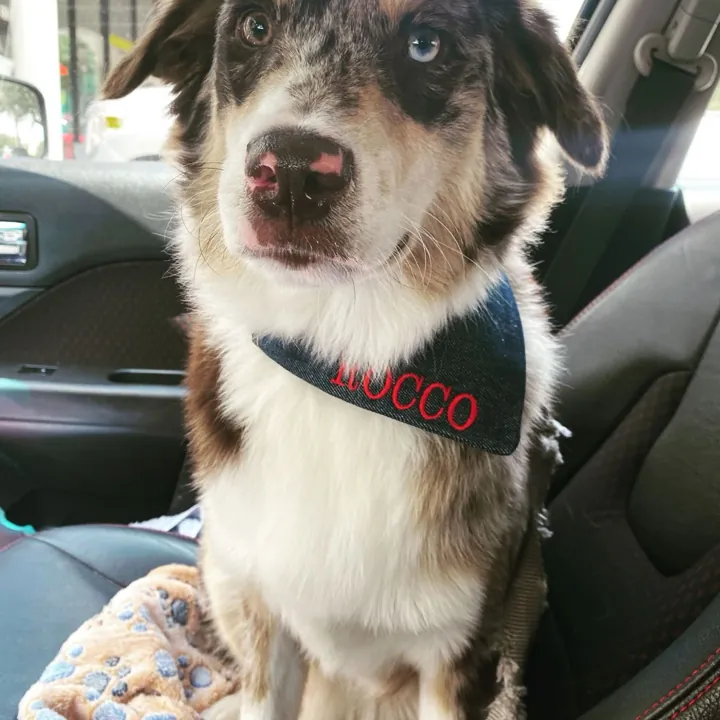
Rocco was my Australian Shepherd. He had one blue eye and one brown one, and in July 2026, at about seven years old, he was diagnosed with a mass in his brain. In September, we had to say goodbye.
I’m writing this for two reasons. First, because the early signs were subtle and confusing, and I spent a lot of nights searching for answers that other owners might be searching for right now. Second, because going through it is the reason this site has a section for dogs at all — and why that section is careful about what regenerative medicine can and can’t do.
This is my experience, not veterinary advice. Where I explain medical terms, I link to veterinary sources. Rocco did not receive stem cell, PRP, or any other regenerative treatment.
Who Rocco was
I got Rocco from a breeder in Lake Nona, Florida.
Rocco loved walks, including on the golf course, and he pulled hard on the leash the whole way. He’d snap a tossed piece of pizza crust out of the air. And he had a funny habit: if you rubbed the base of his back, right above his tail, he’d start licking his lips every time.
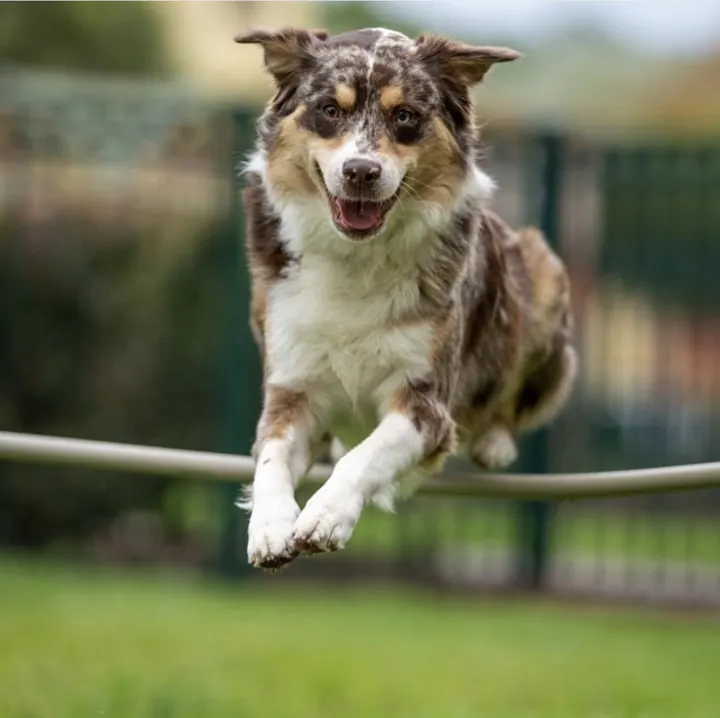
More than anything, he was always by my side. He followed me everywhere, like a shadow. And every night he was ready for bed before I was — he’d let me know it was our bedtime.
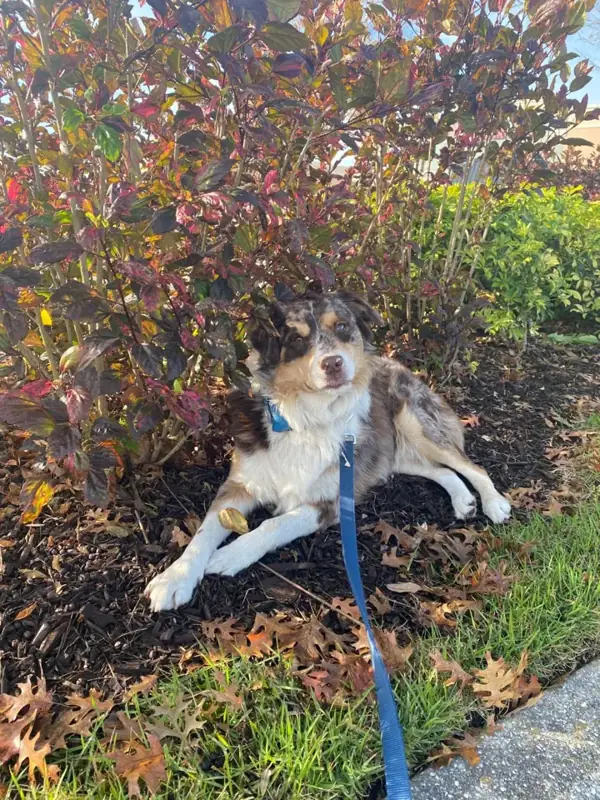
The first signs: walking close to the walls
It started suddenly on July 23, 2026. Rocco was walking very close to walls, sometimes bumping into them. Something was off with his eyes — they didn’t look aligned, and he wasn’t blinking normally on his left side. He seemed unsure of himself, a little off balance.
Before that day, nothing had seemed wrong. He was eating, acting like himself, going to the bathroom normally. Looking back, the change was so sudden that I didn’t know whether I was looking at an eye problem, an ear problem, or something else entirely.
An emergency visit, then a different answer
We went to an emergency veterinary hospital that night. The pressure in his left eye measured high, and the ER vet diagnosed acute glaucoma, gave him pain medication, and sent us home with eye drops and gabapentin.
The next morning we saw a board-certified veterinary ophthalmologist. His eye pressures were now normal in both eyes, and a closer exam of the drainage angle of his eyes was normal too. She ruled out glaucoma. What she found instead was that his blink on the left side was weak and inconsistent — both on its own and when she touched that side of his face. Her diagnosis was a problem with his left trigeminal nerve, the nerve that gives the face sensation and drives the blink reflex. She prescribed a lubricating eye gel to protect his eye, since a dog that doesn’t blink well can injure the cornea without feeling it.
She also told us that this kind of nerve problem can sometimes be caused by a mass pressing on the nerve, and that imaging — an MRI or CT — was the way to find out.
What I learned: a first diagnosis can change. The ER did what ER vets do — treat what’s in front of them that night — and the specialist the next morning had the time and tools to look deeper. If something doesn’t add up, a specialist is worth it.
The weekend: watching the small things
Neurology was booked for Monday. Over the weekend, I watched Rocco closely and wrote everything down:
- He walked slower and more cautiously, especially at night, and stuck to the left side of the sidewalk, sometimes grazing walls.
- When I tossed him a piece of pizza crust, he saw it coming but missed it — then found it on the ground and ate it right away.
- One of his eyes didn’t seem to move side to side the way it should, so he turned his whole head to follow things.
- His lip-licking reaction when I rubbed his back was gone.
- One night he panted and paced for hours and couldn’t settle. I was afraid he was in pain.
I spent that weekend agonizing over whether to wait for Monday or go back to an emergency hospital with a neurologist. If you’re in that spot now: write down what you see, take short videos of your dog walking and of their eyes, and call your vet or an emergency hospital if things get worse quickly. Those notes and videos turned out to be useful.
Neurology and the MRI
On Monday, July 27, a board-certified veterinary neurologist examined Rocco. By then he had a subtle head tilt to the left, he was leaning and sometimes falling to the left, he circled to the left at times, and his eyes made small flicking movements in certain head positions. She described these as vestibular signs — problems with the balance system. His ears looked normal, his bloodwork was unremarkable, and his chest X-rays were clear.
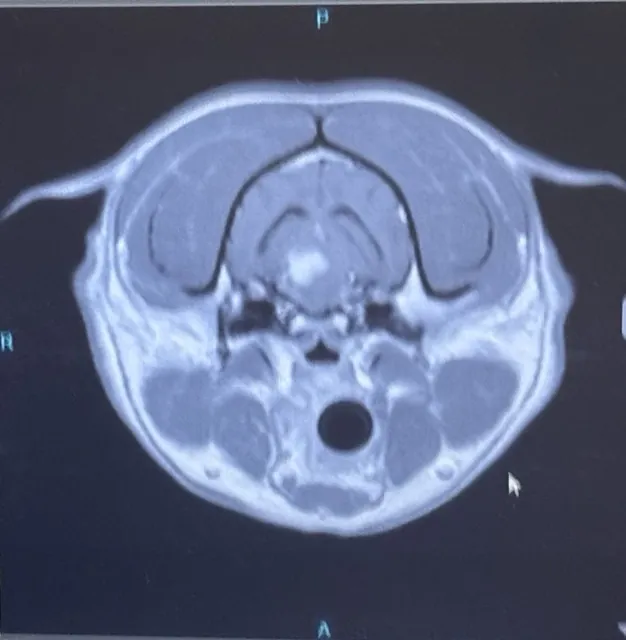
Then came the MRI. It showed a mass deep in the right side of his brain, in an area called the thalamus, with swelling around it.
What the MRI could — and couldn’t — tell us
This is something I didn’t understand at first. The MRI showed us where the mass was and that it was most likely a tumor. But it couldn’t tell us what kind. That usually takes a biopsy — a tissue sample — and getting a sample from deep in the brain carries real risk. We never had a biopsy, so we never knew the exact type.
Deciding what to do next
The neurologist started Rocco on prednisone, a steroid, to bring down the swelling around the mass. The discharge notes were honest about it: it was meant to reduce the swelling and help him feel better, not to shrink the tumor or stop it from growing.
She recommended a consultation with a radiation oncologist. I also looked into clinical trials for dogs with brain tumors and put together Rocco’s full medical history so a trial team could review it.
Surgeons generally don’t want to operate on a mass that deep in the brain, so I started looking beyond the usual path. Some places offer alternative medicine and herbal remedies for dogs with serious brain tumors that surgeons won’t operate on, and we took Rocco to one of them.
We went to Chi University, near Gainesville. The visit was amazing — one of the best experiences I’ve ever had.
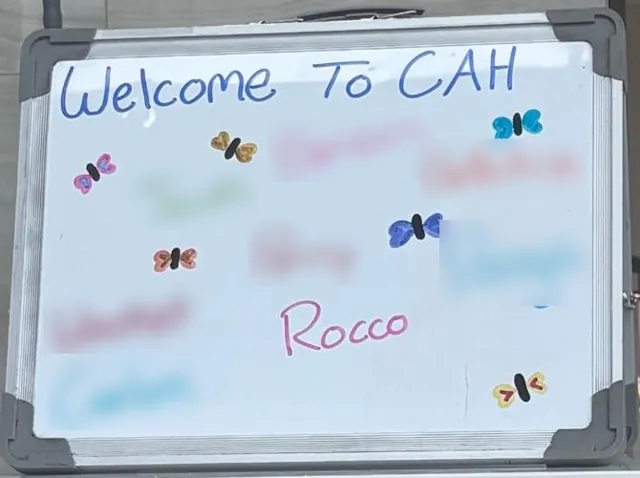
Searching for every possible option showed me how hard it is for owners to tell what’s backed by evidence and what’s only hope. That’s a big part of why this site exists.
The last weeks
Walking was one of Rocco’s favorite things in the world. We had a routine: a walk every morning at 6 a.m., and another right as the sun went down. In the first week after his diagnosis, he didn’t want to walk much anymore. That’s when I knew how serious this was.
He still ate, and he still went to bed early like he always did. But he kept declining. His appetite wasn’t as big as it used to be, and he walked less and less.
Toward the end, he could barely support his own weight while he was eating. When we let him out into our big backyard, sometimes he would just go into the corners. Those were the signs that told me it was time.
If you’re watching for the same things: the changes I noticed were in his routines — not wanting his favorite walks, eating less, struggling to stand, and going off into corners. Keep your veterinarian updated as you see them, because they can help you understand what each change means and how to keep your dog comfortable.
Saying goodbye
Rocco passed away in September 2026. We had to put him to sleep because he was in so much pain and he couldn’t support his own weight. You could tell the pain was too much for him.
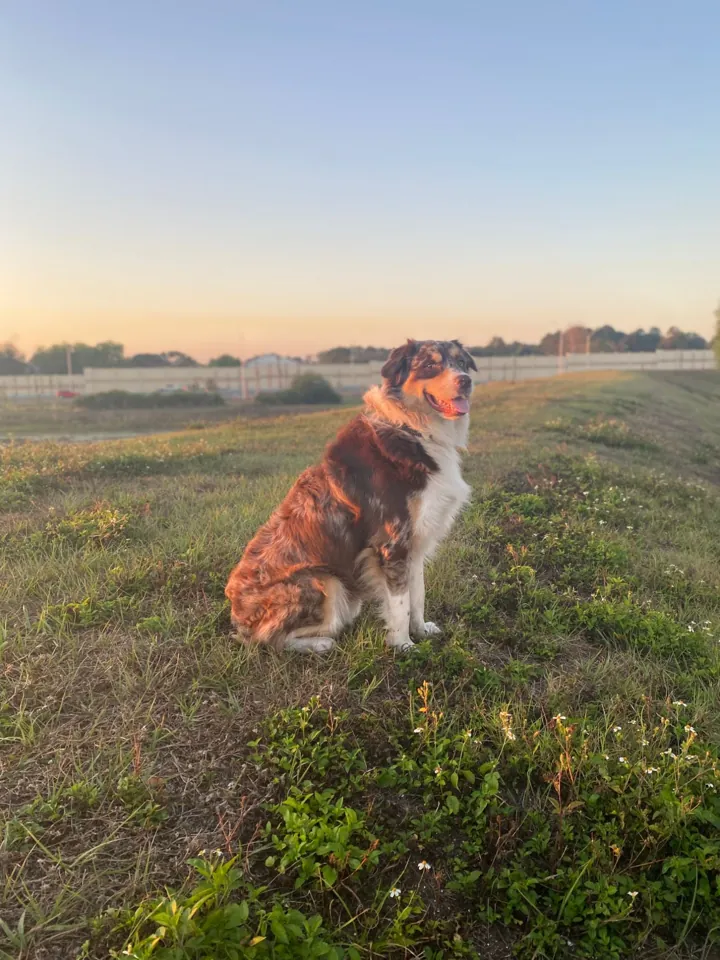
Rocco — my shadow, my walking buddy, and the one who always told me when it was bedtime. Forever by my side.
Deciding when is the hardest part. I kept asking myself whether he was comfortable, whether he could still do the things that made him Rocco, and whether he was having more bad days than good ones. If you’re facing that question, your veterinarian can help you think it through, and there are tools that make it a little less impossible.
What I wish every dog owner knew
- Small changes matter. Walking close to walls, missing treats, a new head tilt, circling, or one eye blinking less are worth a vet visit — especially if they appear suddenly.
- Write it down and film it. Short videos of walking and eye movements, plus dates and times, help your vet more than you’d think.
- A first diagnosis can change. Ask what else it could be, and ask whether a specialist should take a look.
- Ask what each treatment is for. Some medications treat the disease; others ease symptoms. Knowing the difference helps you set expectations.
- Ask about clinical trials and specialists early. Some trials have rules about medications a dog has already started.
- Be careful with promises. No stem cell, PRP, or herbal product has been shown to treat brain tumors in dogs. Tell your vet about anything you’re considering, including supplements.
Questions I asked along the way
- Is this really an eye problem, or could it be neurological?
- Could it be an ear problem? Should his ears be checked?
- Is he in pain, or is the panting and pacing anxiety or a medication side effect?
- What signs mean we should go to the emergency hospital now instead of waiting?
- What will an MRI tell us, and what won’t it tell us?
- Is radiation an option? Are there clinical trials he might qualify for?
- How do we measure his comfort and quality of life day to day?
Where regenerative medicine fits — and where it doesn’t
People sometimes assume that because I run a site about regenerative medicine, I must have tried it for Rocco. I didn’t, and it wouldn’t have been appropriate. Stem cell and PRP treatments for dogs are mainly studied for arthritis and joint problems. They are not cancer treatments, and no stem cell product is FDA-approved for animals. Our guide to regenerative medicine for dogs explains what the research does and doesn’t show.
Frequently asked questions
Learn what regenerative medicine can and can’t do for dogs
An honest, sourced guide to stem cell and PRP treatments for dogs with arthritis, dysplasia, and ligament injuries.
Read the Dog GuideRelated reading
- Regenerative Medicine for Dogs: Stem Cells, PRP & the Evidence
- Stem Cell Therapy for Dogs: What the Research Says